
Introduction
Ammonia (NH₃) is a colorless gas with a pungent smell. It is highly soluble in water and shows basic properties. The laboratory preparation of ammonia is an important topic for Class 10 Chemistry and is commonly asked in examinations.
Preparation of Ammonia Gas in the Laboratory
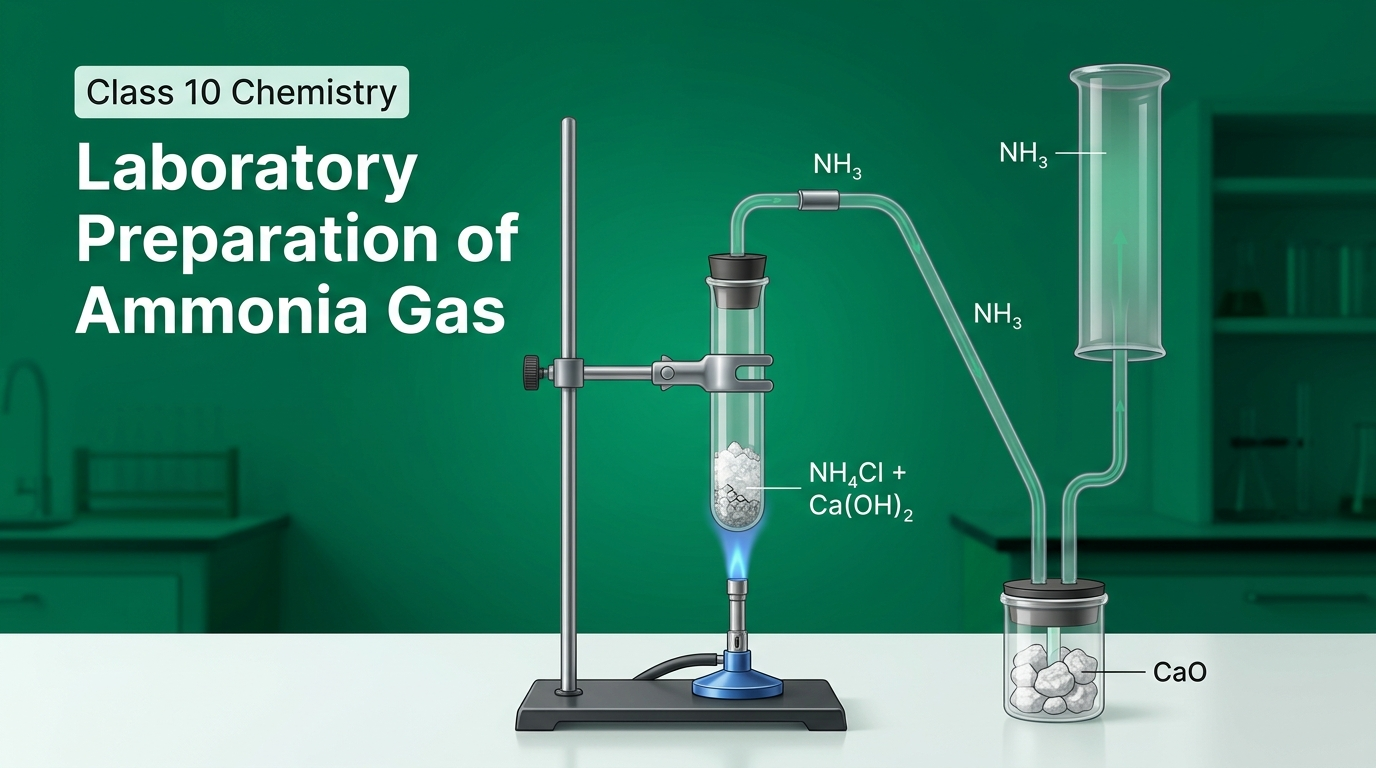
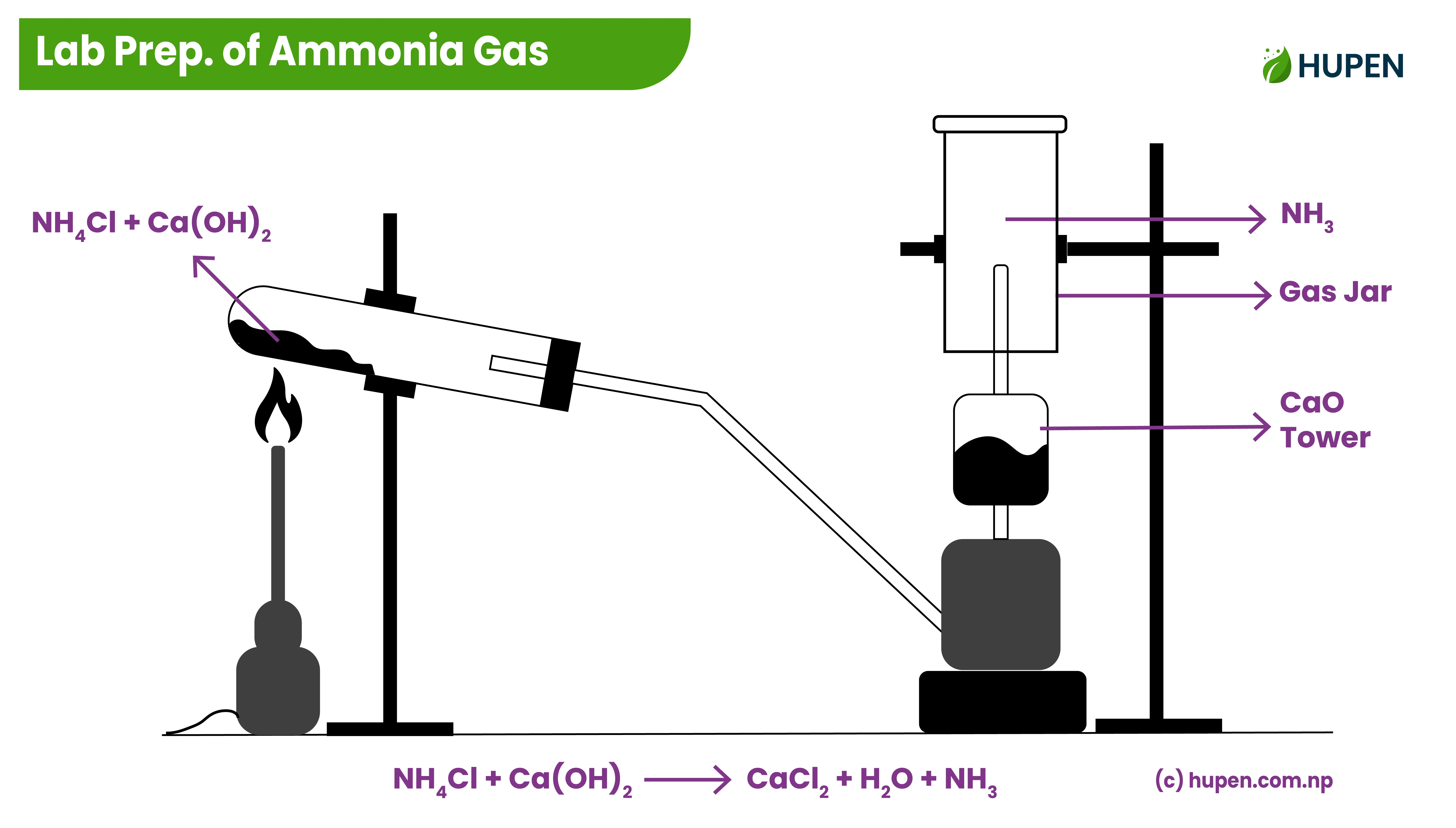
Ammonia gas is prepared by heating a mixture of ammonium chloride (NH₄Cl) and calcium hydroxide [Ca(OH)₂].
The balanced chemical equation is:
When the mixture is heated, ammonia gas is produced. The gas is then passed through quicklime (CaO) to remove moisture.
Why is quicklime used?
Quicklime acts as a drying agent. It removes water vapour from ammonia without reacting significantly with the gas.
Collection of Ammonia Gas
Ammonia is highly soluble in water, so it cannot be collected over water.
It is collected by downward displacement of air because ammonia is lighter than air.
Tests for Ammonia
Ammonia can be identified by these simple tests:
- Moist red litmus paper turns blue, showing that ammonia is basic.
- When ammonia reacts with hydrogen chloride gas, dense white fumes of ammonium chloride are formed.
NH₃ + HCl → NH₄Cl
Quick Revision
| Feature | Answer |
|---|---|
| Formula | NH₃ |
| Reactants | NH₄Cl + Ca(OH)₂ |
| Method of preparation | Heating |
| Drying agent | Quicklime (CaO) |
| Collection method | Downward displacement of air |
| Solubility | Highly soluble in water |
| Nature | Basic |
| Test | Red litmus turns blue |
| Molecular mass | 17 u |
Practice Questions
- What chemicals are used for the laboratory preparation of ammonia?
- Write the balanced chemical equation for the preparation of ammonia gas.
- Why can ammonia not be collected over water?
- Why is ammonia collected by downward displacement of air?
- Why is quicklime used to dry ammonia gas?
- How can you test ammonia gas?
- What happens when ammonia reacts with hydrogen chloride?
- Write any two properties of ammonia gas.
Explore the Ammonia Gas Simulation
Reading about an experiment is useful, but seeing the experiment makes it easier to understand.
Try the interactive Laboratory Preparation of Ammonia (NH₃) simulation on Hupen and explore the apparatus, preparation, collection, and testing of ammonia gas.
👉 Explore Ammonia Preparation Simulation
Learn, Visualize & Practice
Study the notes, explore the simulation, and test your understanding with practice questions — all in one place on Hupen, a free online learning platform for Nepalese students.
Join the Conversation
0 Comments
Log in to join the discussion
No comments yet
Be the first to share your thoughts!