
Introduction
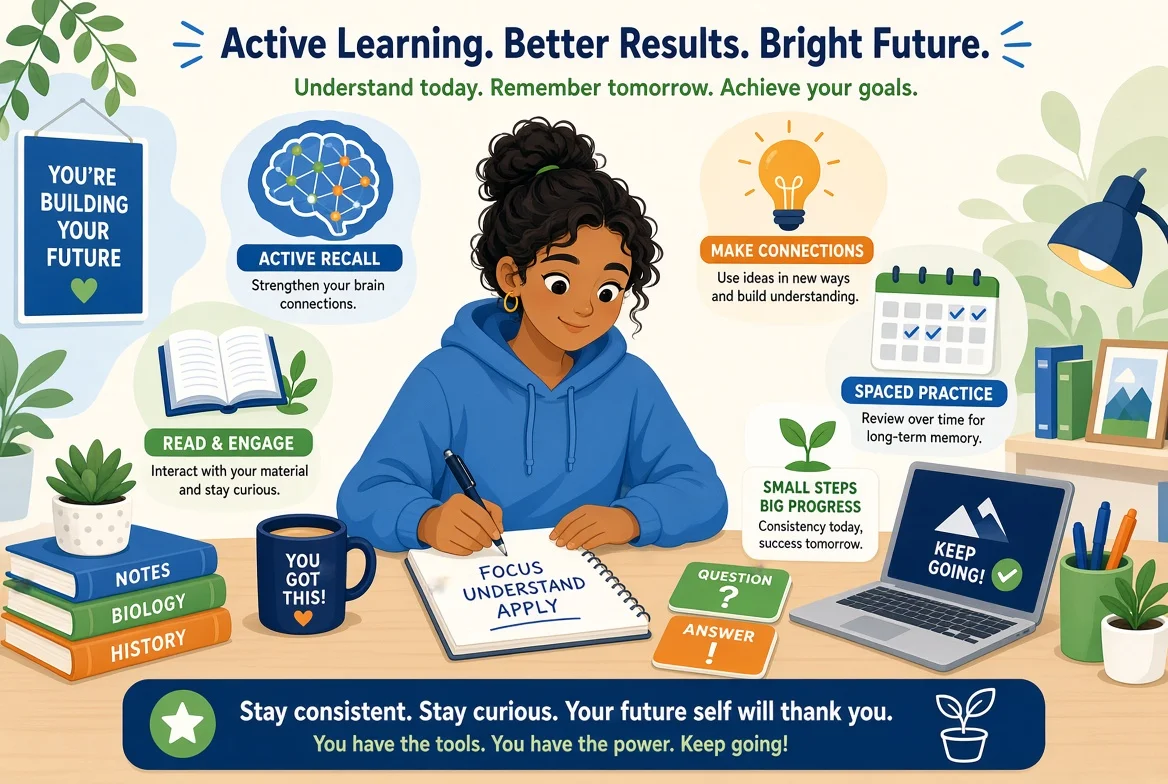
Most students re-read notes, highlight textbooks, and cram the night before exams. It feels productive, but research shows these habits create weak, short-lived memory. Cognitive science offers better alternatives. Switch to evidence-based techniques and you will remember more, understand deeper, and often study less.
Here are seven proven methods you can start using this week.
1. Active Recall
Pull information out of your memory instead of passively reviewing it. Close the book and write or say everything you remember. Use flashcards, practice questions, or teach the material out loud. Every successful retrieval strengthens the memory.
Quick start: After studying, spend five minutes writing what you recall on a blank page, then check and fill the gaps.
2. Spaced Repetition
We forget rapidly unless we review at the right intervals. Space your reviews: one day later, then three days, one week, two weeks. Tools like Anki handle the timing automatically. Even a simple paper calendar works.
3. Interleaving
Mix different topics or problem types in one session instead of blocking them. Alternate algebra and geometry problems, or different historical periods. It feels harder at first but builds stronger discrimination and transfer skills.
4. Elaboration
Explain ideas in your own words and connect them to what you already know. Ask “Why does this work?” or “How is this like something I’ve seen before?” The Feynman Technique is excellent: teach the concept as if explaining it to a 12-year-old.
5. Dual Coding
Combine words with visuals. Draw diagrams, mind maps, timelines, or simple sketches while you study. Creating the image yourself is more powerful than just looking at one.
6. Concrete Examples
Attach abstract ideas to specific, vivid examples. Link a theory to a real event, a formula to an everyday situation, or a historical movement to a particular person and moment. Concrete anchors make concepts stick.
7. Realistic Practice Testing
Take practice tests under exam-like conditions (timed, no notes). This strengthens retrieval, reveals weak spots, and reduces anxiety. After each test, focus more time on analyzing mistakes than on the correct answers.
A Simple Weekly Rhythm
- Learn new material with elaboration and dual coding.
- Review with active recall the next day.
- Mix topics through interleaving mid-week.
- Finish with a timed practice test and error review.
- Use spaced repetition for ongoing reviews.
Why These Feel Harder (and Why That’s Good)
These methods create productive struggle. They feel slower than re-reading at first, but the learning lasts. Start with just one technique this week. Once it becomes a habit, add another.
Sleep, movement, and focused attention multiply the benefits of every technique on this list.
Choose one method and try it today. Consistent use of these evidence-based approaches turns studying from a grind into a reliable skill. Your future self will thank you.



Join the Conversation
0 Comments
Log in to join the discussion
No comments yet
Be the first to share your thoughts!