
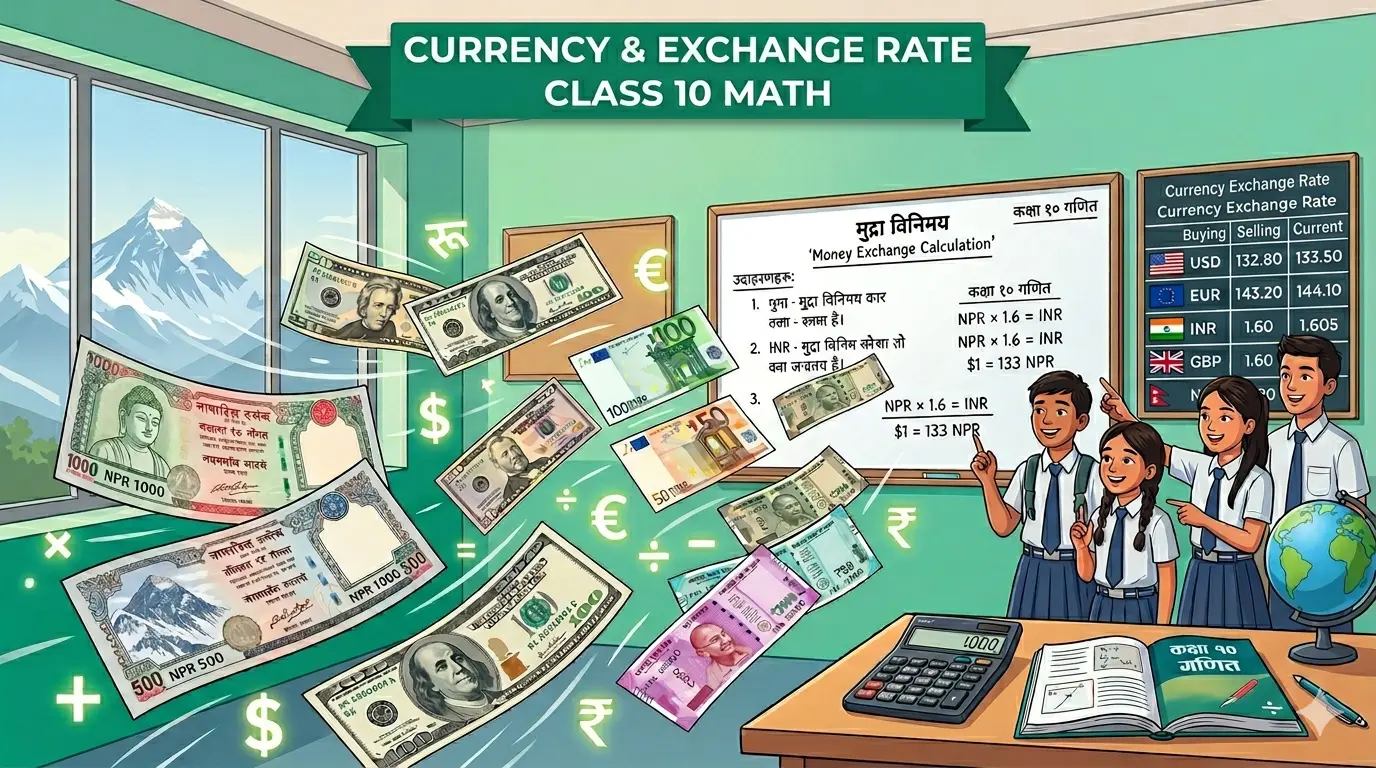
Currency and exchange rate is one of the most practical and important chapters in Class 10 Mathematics. This chapter teaches students how money is converted from one country’s currency to another, how banks determine buying and selling rates, and how currency value changes over time.
This topic is highly useful in:
- Foreign employment
- International trade
- Online business
- Tourism
- Banking and finance
In SEE examinations, students frequently encounter numerical problems related to:
- Buying and selling exchange rates
- Currency conversion
- Chain rule
- Currency devaluation
- Currency revaluation
In this article, you will learn:
- Currency and money exchange
- Exchange rate concepts
- Buying and selling price
- Chain rule method
- Currency devaluation and revaluation
- Worked-out SEE questions
- Important formulas
- Example problems with solutions
Download Resources
PowerPoint Slide: Chapter 4 Currency and Exchange Rate (Class 10 Mathematics)
Video Lesson - Currency and Exchange Rate
What is Currency?
Currency is a system of money used in a country.
Examples:
- Nepal → Nepalese Rupee (NPR)
- India → Indian Rupee (INR)
- United States → US Dollar (USD)
- Japan → Japanese Yen (JPY)
Every country has its own currency for buying and selling goods and services.
What is Money Exchange?
Money exchange means converting one country’s currency into another country’s currency.
Example: If a person travels from Nepal to the USA, Nepalese Rupees must be exchanged into US Dollars.
This conversion is done by banks or money exchange centers.
What is Exchange Rate?
Exchange rate is the value of one country’s currency in terms of another country’s currency.
Example: If: 1 USD = Rs. 133
then Rs. 133 is required to buy 1 US Dollar.
Exchange rates change daily depending on:
- International trade
- Demand and supply
- Economic condition
- Inflation
- Government policy
Buying Rate and Selling Rate
Banks use two different rates:
1. Buying Rate
The rate at which the bank buys foreign currency from customers.
2. Selling Rate
The rate at which the bank sells foreign currency to customers.
Usually: Selling Rate > Buying Rate
because banks earn profit from the difference.
Example of Buying and Selling Rate
Suppose:
1 USD:
- Buying Rate = Rs. 132
- Selling Rate = Rs. 134
This means:
- The bank buys 1 USD for Rs. 132
- The bank sells 1 USD for Rs. 134
Formula for Currency Exchange
1. Foreign Currency to Nepalese Currency
Use buying rate because the bank buys foreign currency from customers.
2. Nepalese Currency to Foreign Currency
Use selling rate because the bank sells foreign currency to customers.
Worked Example 1
Convert USD into Nepalese Currency
Q. If the buying rate of 1 USD is Rs. 132.50, find the Nepalese currency obtained by exchanging 500 USD.
Solution
Using formula:
\(\text{NPR}=500\times132.50\) = Rs. 66,250
Answer: The person receives Rs. 66,250.
Worked Example 2
Convert Nepalese Currency into USD
Q. If the selling rate of 1 USD is Rs. 134, how many dollars can be purchased with Rs. 67,000?
Solution
Using formula:
\(\text{USD}=\frac{67000}{134}\) = 500 USD
Answer: The person can buy 500 USD.
Chain Rule
Chain rule is used when direct exchange between two currencies is unavailable.
The conversion is done through another currency.
Usually: Currency A → USD → Currency B
Formula of Chain Rule
Worked Example on Chain Rule
Q. A person wants to convert 10,000 Indian Rupees into Japanese Yen.
Given:
- 1 INR = NPR 1.6
- 1 JPY = NPR 0.9
Find Japanese Yen.
Solution
First convert INR into NPR:
10,000 × 1.6 = NPR 16,000
Now convert NPR into JPY:
16,000 ÷ 0.9 = 17,777.78 JPY
Answer: The person gets approximately 17,777.78 Japanese Yen.
Currency Devaluation
Currency devaluation means decreasing the value of a country’s currency compared to foreign currencies.
Example: Before: 1 USD = Rs. 120
After: 1 USD = Rs. 130
This means Nepalese currency has weakened. Now, more rupees are needed to buy 1 USD.
Effects of Currency Devaluation
Advantages
- Encourages exports
- Foreign tourists spend more
- Local products become cheaper internationally
Disadvantages
- Imports become expensive
- Fuel prices increase
- Inflation may rise
Currency Revaluation
Currency revaluation means increasing the value of a country’s currency compared to foreign currencies.
Example: Before: 1 USD = Rs. 130 After: 1 USD = Rs. 120
Now fewer rupees are needed to buy 1 USD. This means Nepalese currency has strengthened.
Effects of Currency Revaluation
Advantages
- Imports become cheaper
- Foreign goods cost less
- Inflation may decrease
Disadvantages
- Export becomes expensive
- Foreign buyers may buy less
SEE Worked Out Questions
Question 1
The buying rate of 1 Australian Dollar is Rs. 88.50. How much Nepalese currency will be received by exchanging 700 AUD?
Solution
700\times88.50=61950
Answer: Rs. 61,950
Question 2
The selling rate of 1 Euro is Rs. 145. How many Euros can be purchased with Rs. 72,500?
Solution
\(\frac{72500}{145}=500\)
Answer: 500 Euros
Question 3
A currency changes from: 1 USD = Rs. 125 to 1 USD = Rs. 135
Has the Nepalese currency devalued or revalued?
Solution
More rupees are required to buy 1 USD. Therefore, Nepalese currency has devalued.
Important Points to Remember
- Use buying rate when bank buys foreign currency.
- Use selling rate when bank sells foreign currency.
- Selling rate is always greater than buying rate.
- Chain rule is used when direct conversion is unavailable.
- Devaluation weakens local currency.
- Revaluation strengthens local currency.
Frequently Asked Questions (FAQ)
What is exchange rate?
Exchange rate is the value of one country’s currency in terms of another country’s currency.
Why is selling rate higher than buying rate?
Banks keep profit from the difference between buying and selling rates.
What is currency devaluation?
Currency devaluation means decreasing the value of local currency compared to foreign currency.
What is chain rule in exchange rate?
Chain rule is a method of converting currency through another intermediate currency.
Practice Questions
- Convert 850 USD into Nepalese currency if buying rate is Rs. 133.
- Find Euro obtained from Rs. 87,000 if selling rate is Rs. 145.
- Explain currency devaluation with example.
- Explain difference between buying and selling rate.
- Solve a currency conversion problem using chain rule.
Conclusion
Currency and exchange rate is an important chapter in SEE Mathematics because it connects mathematics with real-life financial activities. Students should clearly understand:
- Buying and selling rates
- Currency conversion
- Chain rule
- Devaluation and revaluation
Practicing numerical problems regularly helps students score good marks in SEE examinations.
Download the PPTX slides and watch the video lesson above for complete chapter understanding.



Join the Conversation
0 Comments
Log in to join the discussion
No comments yet
Be the first to share your thoughts!