Introduction to Scientific Study (Class 10 Science)
Scientific study, also known as scientific investigation or research, is a systematic process of gathering, analyzing, and interpreting information to answer specific questions or test hypotheses. It follows structured scientific methods involving observations, experiments, data collection, and evidence-based conclusions. This foundational unit in Class 10 Science introduces key concepts that form the basis of all scientific inquiry: variables, units, and unit-wise (dimensional) analysis of equations.
Understanding these concepts helps students design proper experiments, ensure measurement consistency, and validate physical equations.
You can study in detail on Scientific Study Lesson.
Variables in Scientific Research
Variables are characteristics or quantities that can change or take different values in an experiment.
Types of Variables:
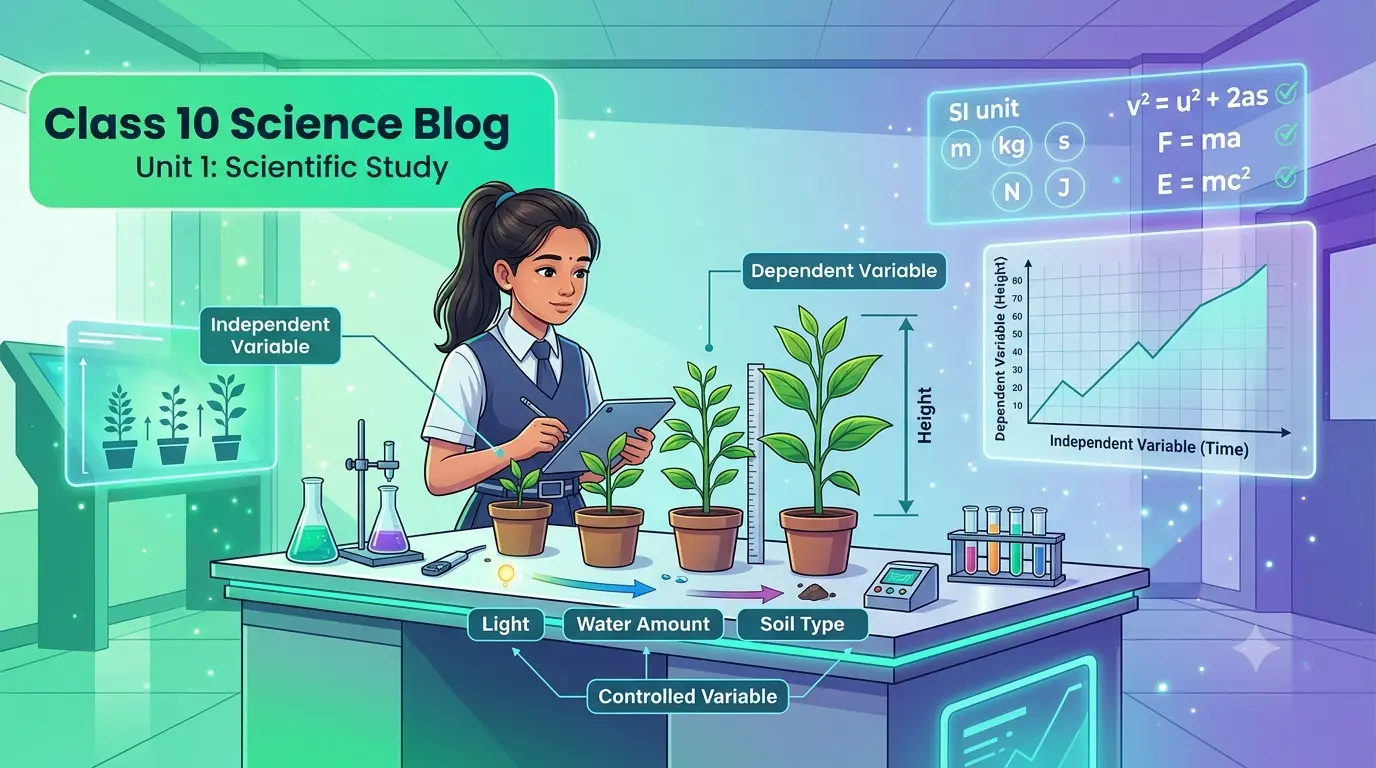
- Independent Variable: The variable that is deliberately changed or manipulated by the researcher. It is not dependent on other variables.
- Dependent Variable: The variable that is measured or observed. It depends on the independent variable.
- Controlled Variables (Constants): Variables that are kept the same throughout the experiment to ensure fair testing.
Example: Investigating the effect of different amounts of water on plant growth.
- Independent Variable: Amount of water
- Dependent Variable: Height of the plant
- Controlled Variables: Amount of sunlight, soil type, initial plant height, humidity, etc.
Important Rules for Variables:
- Only one independent variable per experiment.
- Only one dependent variable per experiment.
- All other variables must be controlled.
- In equations: Dependent variable on the left side, independent on the right.
- In graphs: Dependent variable on the Y-axis, independent on the X-axis.
Units in Measurement
A unit is a standard known quantity used for measurement. Every physical quantity has a unit.
1. Fundamental Units (SI System)
These are independent base units. There are seven fundamental units:
| SN | Physical Quantity | Unit Name | Symbol |
|---|---|---|---|
| 1 | Length | Meter | m |
| 2 | Mass | Kilogram | kg |
| 3 | Time | Second | s |
| 4 | Temperature | Kelvin | K |
| 5 | Luminous Intensity | Candela | cd |
| 6 | Electric Current | Ampere | A |
| 7 | Amount of Substance | Mole | mol |
2. Derived Units
Units formed by combining fundamental units. Examples:
| SN | Quantity | Formula | Unit | Symbol | Fundamental Units |
|---|---|---|---|---|---|
| 1 | Area | l × b | Square meter | m² | m × m |
| 2 | Volume | l × b × h | Cubic meter | m³ | m × m × m |
| 3 | Density | m/V | kg/m³ | kg/m³ | kg / (m³) |
| 4 | Force | ma | Newton | N | kg·m/s² |
| 5 | Pressure | F/A | Pascal | Pa (N/m²) | kg/(m·s²) |
| 6 | Work/Energy | F × d | Joule | J | kg·m²/s² |
| 7 | Velocity | s/t | m/s | m/s | m/s |
Analysis of Unit-wise Equations (Dimensional Analysis)
This technique checks if an equation is valid by verifying that units (dimensions) on both sides are identical.
Steps:
- Identify variables and their units.
- Substitute units into the equation.
- Check if left side = right side dimensionally.
Example 1: ( v^2 = u^2 + 2as )
- Units match (both sides m²/s²) → Valid.
Example 2: ( s = ut + \frac{1}{2}at ) (Note: The second term misses the 't' factor in the original text illustration, but the principle is to show mismatch)
- Units do not match → Invalid.
This method helps detect errors in formulas without performing numerical calculations.
MCQ Questions with Answers
1. What is the variable that is measured in an experiment called?
A) Independent Variable
B) Dependent Variable
C) Controlled Variable
D) Constant
Answer: B) Dependent Variable
2. In the plant growth experiment, the amount of water is:
A) Dependent Variable
B) Controlled Variable
C) Independent Variable
D) None
Answer: C) Independent Variable
3. How many fundamental units are there in the SI system?
A) 5
B) 7
C) 9
D) 10
Answer: B) 7
4. The unit of force is:
A) Joule
B) Pascal
C) Newton
D) Watt
Answer: C) Newton
5. Which of the following is a derived unit?
A) Meter
B) Second
C) Kilogram
D) m/s
Answer: D) m/s
6. In a graph, the dependent variable is plotted on:
A) X-axis
B) Y-axis
C) Both
D) Neither
Answer: B) Y-axis
7. An experiment should ideally have:
A) Multiple independent variables
B) One independent and one dependent variable
C) No controlled variables
D) Only constants
Answer: B) One independent and one dependent variable
8. Dimensional analysis helps to check:
A) Numerical accuracy
B) Unit consistency
C) Graph plotting
D) Hypothesis formation
Answer: B) Unit consistency
9. The SI unit for temperature is:
A) Celsius
B) Fahrenheit
C) Kelvin
D) Rankine
Answer: C) Kelvin
10. Which equation is dimensionally correct? (Basic check)
A) ( s = ut + \frac{1}{2}at^2 )
B) ( v = u + at ) (both correct, but for MCQ purpose)
Wait – standard correct one: Most students know ( v^2 = u^2 + 2as ) is correct.
Additional MCQs (Quick Practice):
11. Controlled variables are also known as:
A) Manipulated variables
B) Constants
C) Response variables
D) Test variables
Answer: B
12. Unit of density is:
A) kg/m²
B) kg/m³
C) m³/kg
D) N/m²
Answer: B
13. In equations, the dependent variable is placed on:
A) Right hand side
B) Left hand side
C) Anywhere
D) Not fixed
Answer: B
14. Pascal is the unit of:
A) Force
B) Pressure
C) Energy
D) Velocity
Answer: B
15. The main purpose of scientific study is to:
A) Generate new knowledge through systematic methods
B) Only perform calculations
C) Avoid experiments
D) Rely on opinions
Answer: A
Conclusion
Unit 1: Scientific Study lays the groundwork for accurate scientific thinking and experimentation. Mastering variables, units, and dimensional analysis will help you excel not only in this chapter but across the entire Class 10 Science syllabus.
Practice these MCQs regularly and refer back to the video lessons on Hupen for visual explanations. Good luck with your SEE preparation!
Feel free to copy this for your website or study notes. Let me know if you need more MCQs, a downloadable PDF version, or explanations for specific parts!