
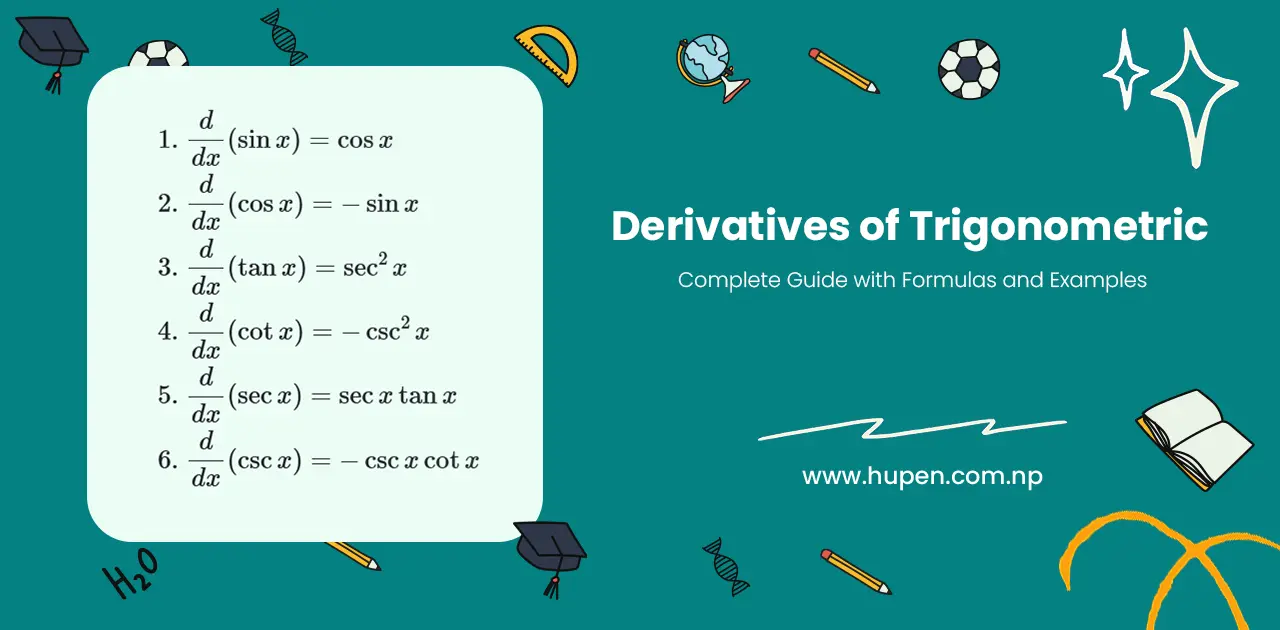
Trigonometric functions such as sin, cos, and tan are fundamental in mathematics. When we study calculus, we often need to find how these functions change with respect to a variable. This is where derivatives of trigonometric functions become important.
In this guide, you will learn:
- What derivatives of trigonometric functions are
- The complete trig derivative formula table
- Easy explanations
- Solved examples for practice
This topic is essential for students studying calculus, physics, and engineering.
Basic Derivatives of Trigonometric Functions
For quick revision, here is a compact trig derivative chart.
Students should memorize these formulas because they appear frequently in calculus problems.
What is the Derivative of a Trigonometric Function?
In calculus, a derivative measures the rate of change of a function with respect to a variable.
If a function is written as: \(f(x)\), its derivative is written as: \(f'(x) \quad \text{or} \quad \frac{d}{dx}f(x) \)
When the function involves trigonometric expressions like sin, cos, or tan, we use special derivative rules called trigonometric derivatives.
For example: \(\frac{d}{dx}(\sin x) = \cos x \)
This means the rate of change of sin x is cos x.



Join the Conversation
0 Comments
Log in to join the discussion
No comments yet
Be the first to share your thoughts!